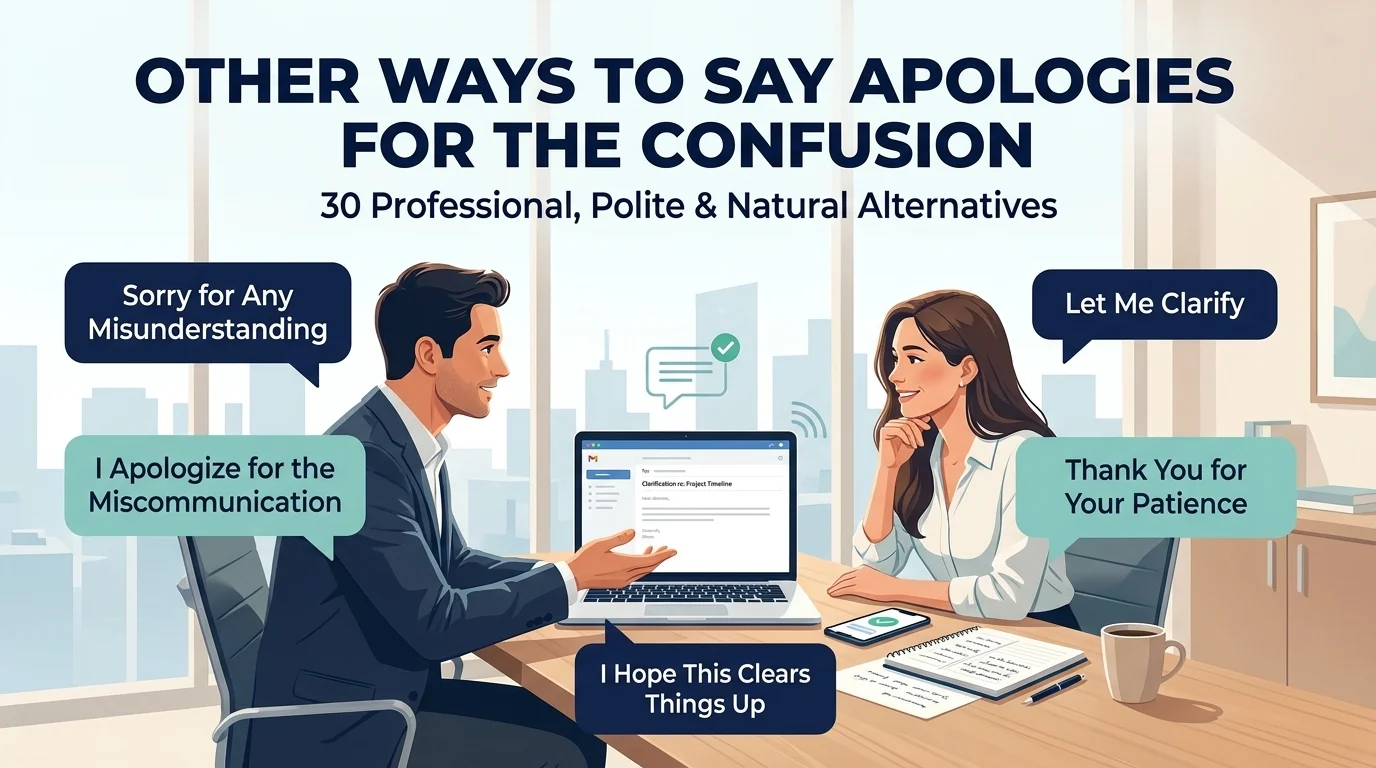
Sometimes, a message, email, or explanation doesn’t come across as clearly as intended. When that happens, saying “Apologies for the confusion” is a polite way to acknowledge a misunderstanding and help everyone get back on the same page. However, using the same phrase repeatedly can make your communication sound less natural, especially in professional emails and workplace conversations.
Fortunately, there are many other ways to say apologies for the confusion, depending on your audience, situation, and tone. Whether you need a formal business expression, a friendly clarification, a professional email apology, or a simple way to correct misinformation, choosing the right words can make a real difference. These 30 alternatives will help you communicate clearly, maintain professional relationships, and resolve misunderstandings with confidence.
Quick Answer for Audience
Here are some of the best alternatives to “Apologies for the confusion”:
- “Sorry for any misunderstanding.”
- “I apologize for the misunderstanding.”
- “I’m sorry that wasn’t clear.”
- “Thank you for your patience while I clarify this.”
- “Please excuse the confusion.”
- “I appreciate your understanding.”
- “Let me clarify what I meant.”
- “I apologize for any inconvenience this may have caused.”
- “I’m sorry for the mixed messages.”
- “Allow me to clear things up.”
1. Sorry for Any Misunderstanding
Best for: Everyday professional emails and workplace conversations.
Alternative: “I’m sorry if my message was unclear.”
Examples:
Sorry for any misunderstanding regarding the meeting schedule.
Sorry for any misunderstanding about the next steps; let me clarify the details.
This is one of the most natural alternatives to “Apologies for the confusion.” It sounds polite, acknowledges the communication issue, and works well when you want to resolve a misunderstanding without making the message overly formal.
2. I Apologize for the Misunderstanding
Best for: Formal emails, client communication, and business correspondence.
Alternative: “Please accept my apologies for the misunderstanding.”
Examples:
I apologize for the misunderstanding regarding the revised contract terms.
I apologize for the misunderstanding and appreciate the opportunity to clarify our expectations.
This expression is slightly more formal than “Sorry for any misunderstanding.” Use it when you want to show accountability and maintain a professional tone.
3. I’m Sorry That Wasn’t Clear
Best for: Explaining unclear instructions or messages.
Alternative: “I should have explained that more clearly.”
Examples:
I’m sorry that wasn’t clear. The deadline is Friday, not Thursday.
I’m sorry that wasn’t clear in my previous email. The updated policy applies starting next month.
This phrase is useful when your original message may have lacked clarity. It sounds genuine and focuses on making the information easier to understand.
4. Thank You for Your Patience While I Clarify This
Best for: Customer service, workplace emails, and complicated explanations.
Alternative: “Thank you for giving me the opportunity to explain.”
Examples:
Thank you for your patience while I clarify the changes to your order.
Thank you for your patience while I explain how the new process works.
Sometimes, a positive expression of appreciation is more effective than repeating an apology. This wording recognizes the other person’s time while helping you move the conversation forward.
5. Please Excuse the Confusion
Best for: Polite business communication and brief email corrections.
Alternative: “Please forgive the misunderstanding.”
Examples:
Please excuse the confusion regarding the appointment time.
Please excuse the confusion caused by the two different versions of the document.
This phrase is concise, courteous, and suitable for situations where a short acknowledgment is enough.
6. I Appreciate Your Understanding
Best for: Professional emails, schedule changes, and clarifications.
Alternative: “Thank you for understanding.”
Examples:
The original deadline has changed to Monday. I appreciate your understanding.
I realize the updated instructions may have caused some uncertainty, and I appreciate your understanding.
This expression emphasizes cooperation rather than dwelling on the mistake. It works particularly well when you have already explained what changed.
7. Let Me Clarify What I Meant
Best for: Conversations where your intended meaning was misunderstood.
Alternative: “Allow me to explain that more clearly.”
Examples:
Let me clarify what I meant by the proposed changes to the project.
Let me clarify what I meant in my earlier message: the offer applies to new customers only.
This is a practical alternative when you want to correct a misunderstanding immediately. It moves the conversation toward a clear explanation instead of focusing only on the apology.
8. I Apologize for Any Inconvenience This May Have Caused
Best for: Customer support, service updates, and formal business emails.
Alternative: “I’m sorry for any trouble this may have caused.”
Examples:
I apologize for any inconvenience this may have caused while we corrected your billing information.
I apologize for any inconvenience caused by the unexpected change to our delivery schedule.
This phrase is appropriate when the misunderstanding has affected someone’s time, plans, or work. If you know exactly what went wrong, briefly explain the issue as well.
9. I’m Sorry for the Mixed Messages
Best for: Conflicting instructions or inconsistent information.
Alternative: “I apologize for providing inconsistent information.”
Examples:
I’m sorry for the mixed messages about which report needs to be submitted.
I’m sorry for the mixed messages regarding the new attendance policy.
Use this expression when someone has received different or contradictory information. It acknowledges the specific communication problem without sounding unnecessarily complicated.
10. Allow Me to Clear Things Up
Best for: Professional discussions and straightforward clarifications.
Alternative: “Let me set the record straight.”
Examples:
Allow me to clear things up: the meeting will take place online.
Allow me to clear things up regarding the payment terms mentioned in my last email.
This phrase sounds confident and solution-oriented. It is especially useful when a quick explanation can resolve the misunderstanding.
11. I Should Have Explained That Better
Best for: Taking responsibility for unclear communication.
Alternative: “I could have communicated that more clearly.”
Examples:
I should have explained that better. The new procedure begins next week.
I should have explained that better in our meeting; the figures were preliminary estimates.
This alternative shows accountability without becoming overly dramatic. It is useful when you recognize that your explanation contributed to the confusion.
12. Thank You for Pointing That Out
Best for: Responding to someone who identifies unclear information.
Alternative: “I appreciate you bringing this to my attention.”
Examples:
Thank you for pointing that out. I’ll clarify the instructions for everyone.
Thank you for pointing that out; I can see how the wording could be misunderstood.
This response acknowledges the other person’s feedback and creates an opportunity to correct the issue. It is particularly effective in collaborative work environments.
13. I Didn’t Mean to Cause Any Confusion
Best for: Friendly professional conversations and informal emails.
Alternative: “That wasn’t my intention, and I’m sorry for the misunderstanding.”
Examples:
I didn’t mean to cause any confusion about who would lead the presentation.
I didn’t mean to cause any confusion with my earlier message; I was referring to the updated schedule.
This phrase explains your intention while recognizing that the message may have been interpreted differently. Follow it with a clear explanation to avoid further misunderstanding.
14. Sorry for the Unclear Instructions
Best for: Managers, teachers, project leads, and team communication.
Alternative: “I apologize for not making the instructions clearer.”
Examples:
Sorry for the unclear instructions. Please submit the completed form by Wednesday.
Sorry for the unclear instructions in the project brief; I’ve updated the document with the missing details.
This is a direct and practical option when the problem involves directions, requirements, or expectations. It also helps establish what needs to happen next.
15. I Regret the Confusion Caused
Best for: Formal correspondence and official business communication.
Alternative: “I regret any misunderstanding resulting from my earlier message.”
Examples:
I regret the confusion caused by the revised pricing information.
I regret the confusion caused by the previous announcement and would like to confirm the correct dates.
This wording is more formal and reserved than everyday expressions. Use it for official notices or business situations where a measured tone is appropriate.
16. Let Me Correct That
Best for: Correcting an inaccurate statement or detail.
Alternative: “I’d like to correct something I said earlier.”
Examples:
Let me correct that: the workshop starts at 10 a.m., not 11 a.m.
Let me correct that figure in my previous email; the total should be $850.
This phrase is helpful when the source of confusion is a specific mistake. State the correct information immediately so the other person does not have to guess.
17. I See How That Could Have Been Misunderstood
Best for: Sensitive discussions and resolving communication issues.
Alternative: “I understand why my message may have been unclear.”
Examples:
I see how that could have been misunderstood, and I want to clarify my original point.
I see how the wording could have caused confusion about the responsibilities involved.
This expression demonstrates empathy by acknowledging the other person’s perspective. It is useful when you want to resolve an issue without sounding defensive.
18. Sorry for the Lack of Clarity
Best for: Professional writing, reports, and detailed explanations.
Alternative: “I apologize for not providing enough detail.”
Examples:
Sorry for the lack of clarity in the instructions for completing the application.
Sorry for the lack of clarity in my earlier update; the project remains on schedule.
Choose this wording when your message omitted important details or left room for interpretation. It is straightforward and appropriate for both email and workplace communication.
19. I Want to Make Sure We’re on the Same Page
Best for: Team meetings, project discussions, and collaborative work.
Alternative: “Let’s make sure we’re working with the same information.”
Examples:
I want to make sure we’re on the same page about the final project deadline.
I want to make sure we’re on the same page regarding each team member’s responsibilities.
This expression focuses on shared understanding rather than blame. It is particularly useful when several people need to agree on plans, deadlines, or expectations.
20. My Apologies for the Miscommunication
Best for: Professional emails and situations involving incorrect or inconsistent messages.
Alternative: “I apologize for the communication mix-up.”
Examples:
My apologies for the miscommunication about the delivery date.
My apologies for the miscommunication between our teams regarding the requested changes.
This is a natural alternative when information was not communicated correctly between people or departments. If possible, explain the correct information in the same message.
21. I Appreciate Your Help in Clearing This Up
Best for: Collaborative conversations and resolving shared misunderstandings.
Alternative: “Thanks for helping us clarify the situation.”
Examples:
I appreciate your help in clearing this up before we finalize the report.
I appreciate your help in clearing this up with the client.
This phrase shows gratitude and encourages cooperation. It works well when the other person has helped identify the issue or contributed to finding a solution.
22. Please Allow Me to Rephrase That
Best for: Formal discussions, presentations, and written explanations.
Alternative: “Let me put that another way.”
Examples:
Please allow me to rephrase that: the discount applies to the annual plan only.
Please allow me to rephrase my earlier point so the requirements are easier to understand.
This expression is useful when the original wording was confusing, even if the information itself was correct. A simpler explanation can often solve the problem immediately.
23. I’m Sorry for the Oversight
Best for: Missing details, overlooked updates, and administrative mistakes.
Alternative: “I apologize for overlooking that detail.”
Examples:
I’m sorry for the oversight; I forgot to include the updated attachment.
I’m sorry for the oversight in the original announcement. The correct venue is Room 204.
Use this phrase when confusion resulted from something you missed or forgot to include. It is more specific than a general apology and can sound professional without being overly formal.
24. I Understand the Confusion
Best for: Customer communication and discussions involving unclear information.
Alternative: “I can see why that information was confusing.”
Examples:
I understand the confusion because the two notices listed different dates.
I understand the confusion, and I’d like to explain how the updated policy works.
This response acknowledges the situation without dismissing the other person’s concerns. Follow it with a factual explanation so the conversation can move toward a resolution.
25. Sorry for the Conflicting Information
Best for: Policy updates, schedules, pricing, and official announcements.
Alternative: “I apologize for the inconsistent details.”
Examples:
Sorry for the conflicting information about the registration deadline.
Sorry for the conflicting information in the two reports; the revised figures are listed below.
This phrase works best when different sources or messages provide inconsistent details. Identify which information is correct to prevent the same issue from happening again.
26. I Hope This Clears Things Up
Best for: Follow-up emails and messages after an explanation.
Alternative: “I hope this explanation helps clarify the situation.”
Examples:
The revised schedule is attached. I hope this clears things up.
I’ve explained the difference between the two options below. I hope this clears things up.
This phrase is a friendly way to end a clarification. It signals that you’ve addressed the misunderstanding while leaving room for further questions.
27. Thank You for Giving Me the Chance to Clarify
Best for: Professional discussions and sensitive misunderstandings.
Alternative: “I appreciate the opportunity to explain.”
Examples:
Thank you for giving me the chance to clarify the expectations for this assignment.
Thank you for giving me the chance to clarify my earlier comments about the proposal.
This expression conveys appreciation and keeps the tone constructive. It is especially useful when another person has asked for an explanation rather than making assumptions.
28. I Apologize for the Ambiguity
Best for: Formal writing, technical documents, and detailed instructions.
Alternative: “I’m sorry the wording left room for interpretation.”
Examples:
I apologize for the ambiguity in the contract wording; I’ll confirm the intended meaning.
I apologize for the ambiguity in the project requirements and will provide a more precise description.
“Ambiguity” refers to wording that can have more than one interpretation. This expression is useful in formal contexts where precision matters, although a simpler phrase may work better in casual conversations.
29. Let Me Explain the Situation More Clearly
Best for: Complex issues, workplace updates, and customer support.
Alternative: “Allow me to provide some additional context.”
Examples:
Let me explain the situation more clearly: the original booking was canceled, but a new one has been confirmed.
Let me explain the situation more clearly so everyone understands why the deadline changed.
This phrase works when the misunderstanding involves several details rather than a single incorrect word. Organizing your explanation into clear points can help prevent additional questions.
30. I’m Sorry for the Confusion, and Here’s the Correct Information
Best for: Direct apologies, correction emails, and customer communication.
Alternative: “My apologies for the mix-up. Here’s what you need to know.”
Examples:
I’m sorry for the confusion, and here’s the correct information: your appointment is scheduled for Tuesday at 2 p.m.
I’m sorry for the confusion. The revised invoice reflects the correct total, and I’ve attached a copy for your reference.
This is one of the most useful all-purpose alternatives because it combines an apology with a practical solution. It acknowledges the issue and immediately gives the reader the information they need.
Frequently Asked Questions
1. What is a professional way to say “Apologies for the confusion”?
You can say, “I apologize for the misunderstanding,” “My apologies for the miscommunication,” or “I regret the confusion caused.” These phrases work well in formal emails, client communication, and workplace discussions.
2. What is another way to say “Sorry for the confusion” in an email?
Try “I’m sorry that wasn’t clear,” “Please excuse the misunderstanding,” or “Thank you for your patience while I clarify this.” Follow the phrase with the correct details so the recipient understands what has changed.
3. Is “Apologies for the confusion” grammatically correct?
Yes. “Apologies for the confusion” is a widely used and grammatically acceptable expression. It is concise and professional, although “I apologize for the confusion” may sound more personal and direct.
4. How do you apologize for a misunderstanding without sounding unprofessional?
Acknowledge the issue, use polite language, and provide a clear explanation. For example: “I’m sorry my earlier message wasn’t clear. To clarify, the deadline is Friday.” This approach demonstrates accountability and helps resolve the issue efficiently.
5. Should you say “Sorry for the confusion” or “Sorry for the misunderstanding”?
Both are appropriate. “Sorry for the confusion” is useful when information or instructions were unclear. “Sorry for the misunderstanding” is more specific when someone interpreted a message differently from what you intended.
Conclusion
Knowing other ways to say apologies for the confusion helps you communicate more naturally in emails, workplace discussions, customer service messages, and everyday conversations. While “Sorry for any misunderstanding” is a reliable all-purpose option, expressions such as “I should have explained that better,” “Let me clarify what I meant,” and “Thank you for your patience” can be more suitable for specific situations.
The key is to match your wording to the context, acknowledge the issue honestly, and explain the correct information clearly. Choose an expression that sounds natural to you, and remember that a thoughtful apology paired with a helpful solution can go a long way toward building trust and maintaining positive professional relationships.
LSI and NLP Keywords
other ways to say apologies for the confusion, professional ways to apologize for confusion, alternatives to sorry for the confusion, formal apology phrases, professional apology email examples, sorry for the misunderstanding, apologies for the miscommunication, how to clarify a misunderstanding, polite ways to apologize, business email apology examples, alternative phrases for apologies, professional clarification phrases, how to correct a misunderstanding, customer service apology phrases, workplace communication examples, formal ways to say sorry, apology wording for emails, phrases for clearing up confusion

I’m Amelia Jane, a passionate writer who loves creating helpful and thoughtful replies. I focus on making conversations easier by sharing simple, natural, and meaningful responses for everyone.