Introduction
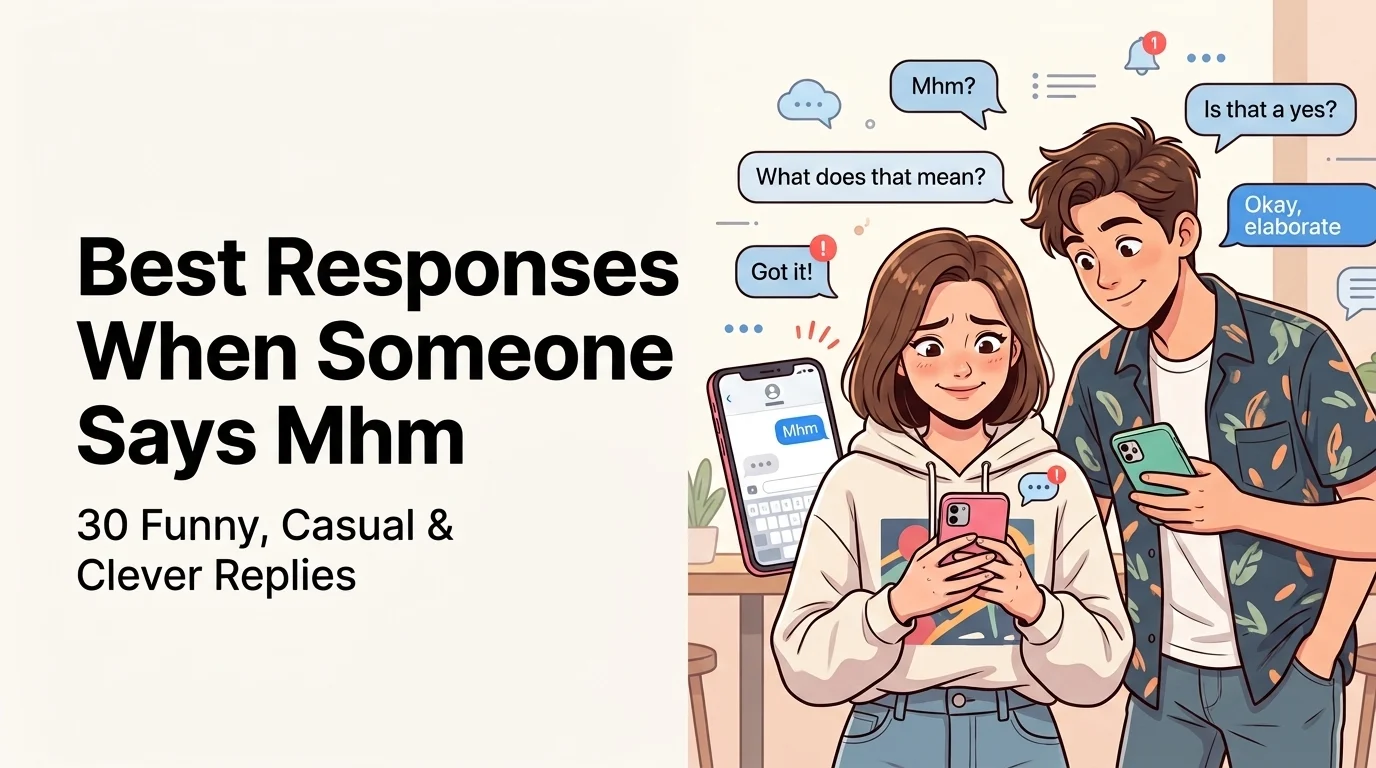
Finding the Best Responses When Someone Says Mhm can be surprisingly tricky. “Mhm” is a short response that can mean “yes,” “I agree,” “I understand,” or simply “I’m listening.” Its meaning often depends on the conversation, the person’s tone, and the context in which they use it.
If you’re texting a friend, chatting with a classmate, or having a casual conversation, your response can keep things moving instead of letting the conversation become awkward. Sometimes a simple “Okay!” is enough, while other situations call for a funny, playful, curious, or thoughtful reply. Here are practical responses for different moods and situations.
Quick Answer: What Should You Say When Someone Says Mhm?
The best response depends on the context. For a casual conversation, try “Okay, got you!” For a funny reply, use “That sounded very convincing.” If you want to keep the conversation going, ask “What are you thinking?”
1. “Okay, Got You!”
Best for: Casual conversations.
Alternative: “Alright, I understand.”
Examples:
“Okay, got you! That makes sense.”
“Alright, I understand what you mean.”
This is a simple response when “mhm” seems to mean agreement or understanding.
2. “Sounds Good!”
Best for: Plans and casual agreements.
Alternative: “Perfect!”
Examples:
“Sounds good! See you tomorrow.”
“Perfect, we’re on the same page.”
It keeps the conversation positive and moving.
3. “Is That a Yes?”
Best for: When you’re unsure what “mhm” means.
Alternative: “Should I take that as a yes?”
Examples:
“Is that a yes, or are you still deciding?”
“Can I officially count that as a yes?”
This is useful when the short reply is ambiguous.
4. “Mhm to You Too!”
Best for: Playful texting.
Alternative: “Mhm right back!”
Examples:
“Mhm to you too 😂.”
“Mhm right back at you!”
Mirroring the response can turn a simple text into a playful exchange.
5. “That’s a Very Strong Mhm”
Best for: Friends who enjoy humor.
Alternative: “That was an impressive mhm.”
Examples:
“That’s a very confident mhm.”
“Wow, that mhm sounded serious.”
A little exaggeration makes this response funnier.
6. “I’ll Take That as a Yes”
Best for: When someone seems to agree.
Alternative: “I’m counting that as approval.”
Examples:
“I’ll take that as a yes, then.”
“Alright, I’m officially counting that as agreement.”
It works well when the context clearly suggests agreement.
7. “Everything Okay?”
Best for: When their “mhm” sounds unusually short or distant.
Alternative: “You seem a little quiet. Everything alright?”
Examples:
“Everything okay? That was a very short reply.”
“You good? You seem a little distracted.”
This is better than immediately assuming they’re annoyed.
8. “You Sound Unsure”
Best for: When “mhm” doesn’t sound convincing.
Alternative: “Are you sure about that?”
Examples:
“You sound a little unsure there.”
“Was that a confident mhm or a maybe mhm?”
It gives the person an easy opportunity to clarify.
9. “Fair Enough”
Best for: Neutral conversations.
Alternative: “That’s fair.”
Examples:
“Fair enough, I understand.”
“Alright, that’s fair.”
This response works when there’s nothing more you need to add.
10. “Got It”
Best for: Quick text conversations.
Alternative: “Understood.”
Examples:
“Got it! Thanks for letting me know.”
“Okay, understood.”
It’s short, natural, and doesn’t force the conversation forward.
11. “Anything Else?”
Best for: Conversations where you want clarification.
Alternative: “Want to add anything?”
Examples:
“Anything else you want to tell me?”
“Is there anything more on your mind?”
This gently encourages the person to continue.
12. “That’s All I Get?”
Best for: Close friends and playful conversations.
Alternative: “Only ‘mhm’?”
Examples:
“That’s all I get after that whole explanation?”
“Only mhm? I expected a full review!”
Use this with people who understand your humor.
13. “Very Detailed Response”
Best for: Friendly sarcasm.
Alternative: “What an incredibly detailed answer.”
Examples:
“Wow, very detailed response there.”
“Thank you for the extensive explanation 😂.”
The joke comes from treating a tiny response as if it were a long explanation.
14. “You’re Really Talkative Today”
Best for: Playful conversations with friends.
Alternative: “Someone has a lot to say today.”
Examples:
“You’re really talkative today, huh?”
“Wow, save some words for the rest of us!”
Keep it clearly playful so it isn’t mistaken for criticism.
15. “Should I Keep Going?”
Best for: When you’re telling a story or explaining something.
Alternative: “Want to hear the rest?”
Examples:
“Should I keep going, or was that enough information?”
“Want the rest of the story?”
This gives the other person a chance to show whether they’re interested.
16. “I’m Listening”
Best for: When “mhm” indicates that someone is paying attention.
Alternative: “Go ahead.”
Examples:
“Okay, I’m listening.”
“Got you—go ahead.”
It acknowledges their response and keeps the conversation open.
17. “That’s All?”
Best for: Lighthearted conversations.
Alternative: “Nothing more to say?”
Examples:
“That’s all? I was expecting a bigger reaction.”
“Nothing else? You’re keeping this mysterious.”
This works best when you’re already joking around.
18. “You Agree Then?”
Best for: Confirming someone’s opinion.
Alternative: “So we’re in agreement?”
Examples:
“So you agree with me, then?”
“Okay, so we’re on the same page?”
It’s a natural way to make sure you’ve understood their short response correctly.
19. “Interesting…”
Best for: When you want to sound curious.
Alternative: “Noted.”
Examples:
“Interesting… I’ll remember that.”
“Hmm, interesting response.”
This can be playful or neutral depending on your tone.
20. “I Hear You”
Best for: Understanding someone’s point.
Alternative: “I get what you’re saying.”
Examples:
“I hear you. That makes sense.”
“I get what you mean.”
This response shows that you’re paying attention rather than simply ending the conversation.
21. “Want to Talk About It?”
Best for: When their “mhm” seems unusually quiet.
Alternative: “Do you want to tell me what’s going on?”
Examples:
“You seem quiet. Want to talk about it?”
“If something’s bothering you, I’m here to listen.”
This is a considerate option when the conversation feels different from usual.
22. “Okay Then!”
Best for: Casual and relaxed conversations.
Alternative: “Alright then!”
Examples:
“Okay then! Sounds good.”
“Alright then, let’s go with that.”
It’s a natural way to acknowledge a short agreement.
23. “Noted!”
Best for: Quick, confident replies.
Alternative: “Message received.”
Examples:
“Noted! I’ll keep that in mind.”
“Message received loud and clear.”
This works especially well in casual texting.
24. “Mysterious…”
Best for: When someone gives a vague response.
Alternative: “Very mysterious of you.”
Examples:
“Mhm… mysterious.”
“That was a very mysterious answer.”
It’s playful without requiring a serious response.
25. “You’re Keeping It Short”
Best for: Someone who usually sends longer messages.
Alternative: “Short and sweet today?”
Examples:
“You’re keeping it short today.”
“Short answer, huh? I respect it.”
This works when you already know the person’s usual texting style.
26. “I’ll Pretend That Was Enthusiastic”
Best for: Close friends with a playful sense of humor.
Alternative: “I’m sensing incredible excitement.”
Examples:
“I’ll pretend that was the most enthusiastic mhm ever.”
“Wow, I can practically hear the excitement.”
Use this only when playful teasing is clearly welcome.
27. “Tell Me More”
Best for: When you want to continue the conversation.
Alternative: “Go on.”
Examples:
“Tell me more—I’m curious.”
“Go on, I’m listening.”
This turns a short reply into an opportunity for a deeper conversation.
28. “Okay, I’ll Stop Talking”
Best for: When you think they may not want to continue.
Alternative: “I’ll let you get back to what you were doing.”
Examples:
“Okay, I’ll stop talking for now 😂.”
“I’ll let you get back to your day.”
This can be useful when the conversation seems to be winding down.
29. “What Does That Mhm Mean?”
Best for: Ambiguous conversations.
Alternative: “Can you translate that mhm for me?”
Examples:
“What does that mhm actually mean?”
“Can you translate ‘mhm’ into normal words?”
It’s a fun way to ask for clarification.
30. The All-Purpose Response
Best for: Almost any situation.
Alternative: “Okay, sounds good!”
Examples:
“Okay, sounds good! Let me know what you decide.”
“Got it! We’ll talk later.”
When you’re unsure how to interpret “mhm,” a neutral response is usually the safest choice.
FAQs About Best Responses When Someone Says Mhm
1. What does “mhm” usually mean in texting?
“Mhm” can mean yes, agreement, acknowledgment, or “I’m listening.” The exact meaning depends on the conversation and the person’s tone.
2. What is a funny response to “mhm”?
You can say, “That’s a very detailed response!” or “Wow, very talkative today!” These work best with friends who enjoy playful humor.
3. What should I say if “mhm” sounds annoyed?
Instead of assuming they’re upset, ask politely, “Everything okay?” or “Did I bother you?” Their short response may simply mean they’re busy or distracted.
4. How do I keep a conversation going after “mhm”?
Ask an open-ended question such as “What do you think?”, “Tell me more,” or “How do you feel about it?” This gives the other person something specific to respond to.
5. Is “mhm” rude?
Not necessarily. “Mhm” can be completely normal and friendly. However, a very short or repeated “mhm” may sometimes suggest that someone is distracted, uninterested, or ready to end the conversation.
Conclusion
Choosing the Best Responses When Someone Says Mhm depends mostly on context. A simple “Got it” works for casual conversations, while a playful “That’s a very detailed response!” can add humor when you’re chatting with a friend.
If you’re unsure what the other person means, don’t immediately assume they’re annoyed or uninterested. Ask a simple follow-up question and pay attention to the overall conversation. The best response is one that matches the mood, keeps communication comfortable, and gives the other person room to respond.

I’m Amelia Jane, a passionate writer who loves creating helpful and thoughtful replies. I focus on making conversations easier by sharing simple, natural, and meaningful responses for everyone.