Getting teased about your looks can be uncomfortable, especially when you are caught off guard and do not know what to say. The good news is that you do not need a harsh insult or a long argument to respond. A confident, calm comeback can show that their comment does not control your mood.
The best comebacks when someone makes fun of your looks are usually short, clever, confident, and respectful. Whether you want a funny response, a calm answer, or a firm boundary, the goal is to protect your confidence without turning the situation into a bigger fight. Here are 30 practical responses you can use in different situations.
Quick Answer for Audience
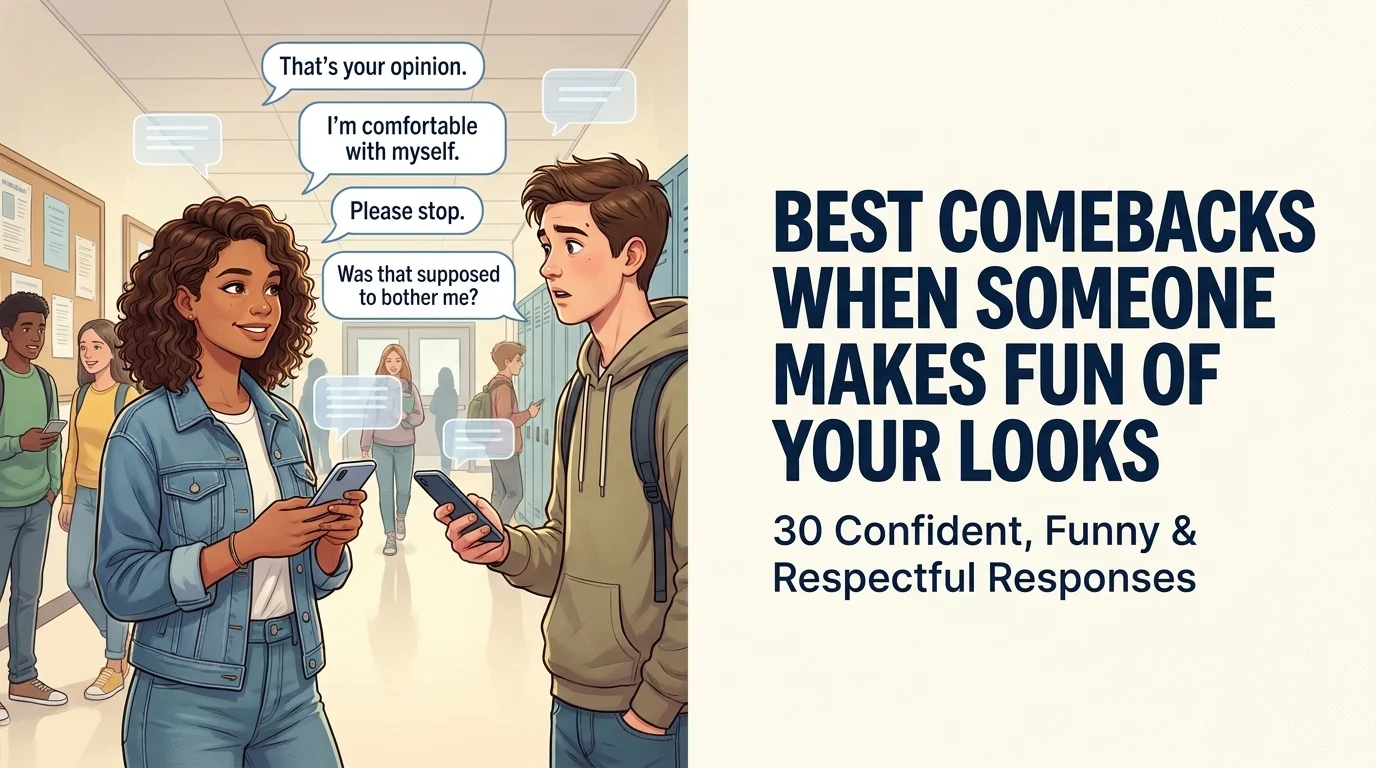
The best comeback is one that keeps your dignity intact. Try responses such as “That’s your opinion,” “I’m comfortable with myself,” “Was that supposed to bother me?” or simply “Okay.” If the teasing continues, stop engaging and tell a trusted adult, teacher, parent, or another person who can help.
1. “That’s Your Opinion”
Sometimes the simplest response is the strongest. You do not have to convince someone to appreciate your appearance.
Best for: Casual teasing or unnecessary opinions.
Alternative: “Everyone has different opinions.”
Examples:
“That’s your opinion, and I’m okay with it.”
“Good thing I don’t need everyone to agree with me.”
2. “I’m Comfortable With Myself”
This response shifts attention away from their comment and toward your confidence.
Best for: Someone repeatedly criticizing your appearance.
Alternative: “I’m happy being myself.”
Examples:
“I’m comfortable with myself, so your comment doesn’t really change anything.”
“I like being myself.”
3. “Was That Supposed to Bother Me?”
A playful question can make an attempted insult lose its impact.
Best for: Light teasing among friends.
Alternative: “Was that supposed to hurt?”
Examples:
“Was that supposed to bother me?”
“Is that the best you came up with?”
4. “Okay…”
A simple “Okay” can be surprisingly effective because it gives the other person very little reaction.
Best for: Someone looking for a reaction.
Alternative: “Alright.”
Examples:
“Okay.”
“Cool story.”
5. “Thanks for Sharing”
You can acknowledge the comment without accepting it as important.
Best for: Unwanted opinions.
Alternative: “Thanks for the information.”
Examples:
“Thanks for sharing your opinion.”
“Appreciate the feedback, I guess.”
6. “I Didn’t Ask”
If someone comments on your appearance without being invited to do so, this is a clear response.
Best for: Unsolicited comments.
Alternative: “I didn’t ask for an opinion.”
Examples:
“I didn’t ask, but thanks.”
“I wasn’t looking for feedback.”
7. “Let’s Talk About Something Else”
Changing the subject can stop the conversation from becoming a competition.
Best for: Friends who are teasing too much.
Alternative: “Can we move on?”
Examples:
“Anyway, what were you saying?”
“Let’s talk about something more interesting.”
8. “You’re Allowed to Think That”
This comeback shows that you do not feel obligated to defend yourself.
Best for: Persistent opinions about your appearance.
Alternative: “You can think whatever you want.”
Examples:
“You’re allowed to think that.”
“That’s fine. I don’t have to agree with you.”
9. “I Like My Style”
Your appearance and personal style do not need someone else’s approval.
Best for: Comments about clothing, hair, or style.
Alternative: “This is what I like.”
Examples:
“I like my style, so I’m good.”
“It works for me, and that’s what matters.”
10. “You Don’t Have to Like It”
Not everyone will have the same taste, and that is perfectly normal.
Best for: Style-based teasing.
Alternative: “Different people like different things.”
Examples:
“You don’t have to like it.”
“It’s not really your choice, though.”
11. “That Wasn’t Very Nice”
Sometimes directly identifying the behavior is better than making another joke.
Best for: Hurtful comments.
Alternative: “That was unnecessary.”
Examples:
“That wasn’t very nice.”
“You could have made your point without being rude.”
12. “Please Stop”
A clear boundary does not need an explanation.
Best for: Repeated teasing.
Alternative: “I want you to stop.”
Examples:
“Please stop making comments about my appearance.”
“I’m serious. Please stop.”
13. “I’m Not Here to Impress You”
This response reminds the other person that their approval is not your responsibility.
Best for: Someone demanding that you look a certain way.
Alternative: “Your approval isn’t necessary.”
Examples:
“I’m not here to impress you.”
“I don’t need your approval to be myself.”
14. “That Says More About You”
A calm comeback can point out that insulting others reflects the speaker’s behavior.
Best for: Deliberate insults.
Alternative: “That says a lot about your attitude.”
Examples:
“Making fun of people says more about you than me.”
“If putting someone down makes you feel better, that’s your choice.”
15. “I’m Good, Thanks”
Keep your answer short and move forward.
Best for: Minor comments you do not want to discuss.
Alternative: “I’m perfectly fine.”
Examples:
“I’m good, thanks.”
“I’m happy with myself.”
16. “Anyway…”
Sometimes refusing to stay on the subject is the comeback.
Best for: People trying to keep an argument going.
Alternative: “Moving on…”
Examples:
“Anyway, what’s the plan?”
“Anyway, I have better things to talk about.”
17. “You Tried”
A playful response can work when the situation is clearly joking rather than genuinely hurtful.
Best for: Friendly banter.
Alternative: “Nice attempt.”
Examples:
“You tried.”
“Nice attempt. Got anything better?”
18. “That’s Not Really My Problem”
You are not responsible for another person’s opinion of you.
Best for: Someone repeatedly trying to get under your skin.
Alternative: “That’s your issue, not mine.”
Examples:
“If you don’t like my look, that’s not really my problem.”
“You’re entitled to your opinion.”
19. “I’m Still Me”
This is a simple confidence-building response.
Best for: Personal comments meant to embarrass you.
Alternative: “Nothing about that changes who I am.”
Examples:
“I’m still me, and I’m perfectly okay with that.”
“One comment doesn’t change who I am.”
20. “You Don’t Know Me”
Appearance does not tell someone everything about a person.
Best for: Strangers or classmates making personal assumptions.
Alternative: “You don’t know what I’m like.”
Examples:
“You don’t know me well enough to judge me.”
“Looks don’t tell you everything about someone.”
21. “I’m Not Going to Argue About It”
Walking away from an argument can be more powerful than winning one.
Best for: Escalating conversations.
Alternative: “I’m not interested in arguing.”
Examples:
“I’m not going to argue about my appearance.”
“This conversation isn’t going anywhere, so I’m done.”
22. “That’s Enough”
A firm boundary can stop repeated jokes.
Best for: Ongoing teasing or bullying.
Alternative: “Enough. Stop.”
Examples:
“That’s enough. Leave my appearance out of it.”
“I’ve heard you. Now stop.”
23. “I Respect Myself”
Confidence does not require putting someone else down.
Best for: Serious comments designed to embarrass you.
Alternative: “I know my worth.”
Examples:
“I respect myself too much to worry about that.”
“I know who I am, and I’m not changing because of your comment.”
24. “Not Everyone Has the Same Taste”
This works especially well for fashion and hairstyle comments.
Best for: Opinions about your style.
Alternative: “Different people like different things.”
Examples:
“Not everyone has the same taste.”
“You don’t have to like my style for me to enjoy it.”
25. “That’s Pretty Rude”
Calling out rude behavior can make your boundary clear.
Best for: Mean-spirited comments.
Alternative: “That was unnecessary.”
Examples:
“That’s pretty rude.”
“You could have kept that comment to yourself.”
26. “I’m Not Taking That Personally”
This response shows emotional distance from the insult.
Best for: Casual comments that are not worth an argument.
Alternative: “I’m not bothered.”
Examples:
“I’m not taking that personally.”
“I’m not going to let that ruin my day.”
27. “Let’s Keep It Respectful”
Respectful communication is especially useful in school or group situations.
Best for: Classmates, teammates, or group conversations.
Alternative: “We can talk without insulting each other.”
Examples:
“Let’s keep the conversation respectful.”
“You can disagree with me without making comments about my looks.”
28. “I’m Walking Away”
Sometimes the strongest comeback is ending the interaction.
Best for: Repeated or aggressive teasing.
Alternative: “I’m done with this conversation.”
Examples:
“I’m walking away because this isn’t productive.”
“I’m not staying here while you make comments about me.”
29. “Tell Me Something I Actually Care About”
This can work as a light, humorous response when the situation is harmless.
Best for: Friendly teasing.
Alternative: “Try a topic I care about.”
Examples:
“Tell me something I actually care about.”
“Interesting. Anyway, what’s new?”
30. The Ultimate Comeback: Stay Calm
Sometimes you do not need a clever sentence at all. Staying calm, refusing to argue, and walking away can make the situation end quickly.
Best for: Persistent teasing or bullying.
Alternative: Say nothing and leave.
Examples:
Look at them calmly, say “Okay,” and walk away.
Say “Please stop,” then move toward a trusted person.
FAQs
What is a good comeback when someone makes fun of your looks?
A good comeback is short and confident, such as “That’s your opinion,” “I’m comfortable with myself,” or “Please stop.”
Should I insult them back?
Usually, no. Insulting them back can turn teasing into a bigger argument. A calm response or clear boundary is often more effective.
What should I say if someone keeps making fun of my appearance?
Tell them clearly to stop. If they continue, walk away and talk to a trusted adult, teacher, parent, counselor, or another person who can support you.
How can I respond without sounding rude?
Use calm phrases like “I’d rather not talk about my appearance,” “Let’s keep it respectful,” or “You’re entitled to your opinion.”
What if the comment actually hurts my feelings?
You do not have to pretend that it did not hurt. Talk to someone you trust and remind yourself that another person’s comment does not determine your value.
Conclusion
The best comebacks when someone makes fun of your looks are not necessarily the funniest or harshest ones. The strongest responses protect your confidence, establish boundaries, and keep you from getting pulled into unnecessary drama.
Choose a response that feels natural to you—whether that is “That’s your opinion,” “Please stop,” “I’m comfortable with myself,” or simply walking away. And if comments about your appearance become repeated bullying, you do not have to handle it alone. Getting support from a trusted person is a smart and confident choice.

I’m Amelia Jane, a passionate writer who loves creating helpful and thoughtful replies. I focus on making conversations easier by sharing simple, natural, and meaningful responses for everyone.